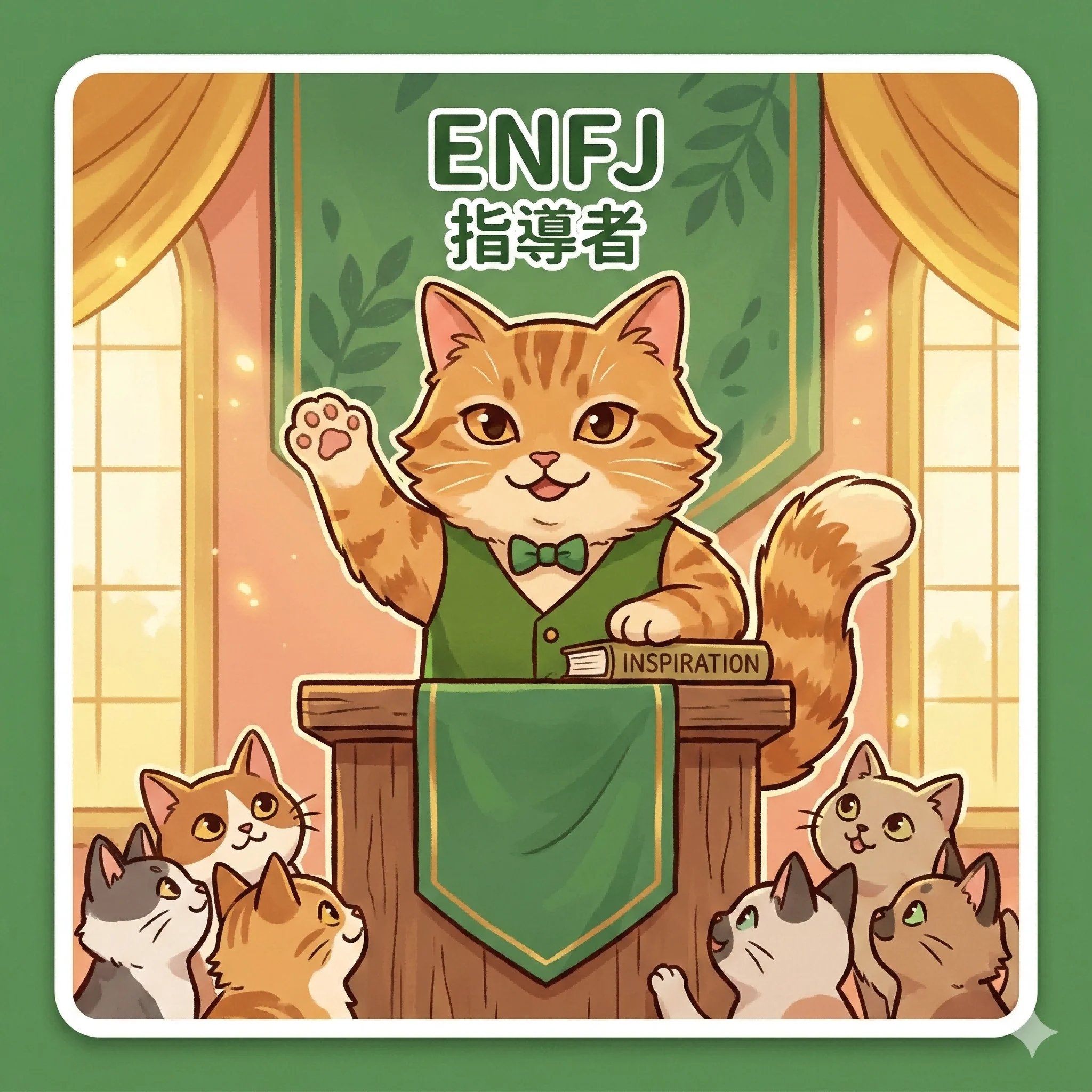
ENFJ: the one who can see who you could become, and cannot unsee it
By Ruby Wang (Wang Yi-Chun) — founder of Hour Light · 2026-09-17
ENFJ gets handed the protagonist, the teacher, the mentor. Flattering, and a trap, because all three put you at the centre of a story about helping. What actually runs underneath is narrower than that: you get a read on where a person is heading, the read arrives whole and early, and once you have it you find it very hard to watch them walk the other way. That is the gift, and it is also the whole problem. This page walks through what that looks like from the inside, and why two people with the same four letters can still feel like opposites.
What the four letters actually describe
The letters are not four separate traits stacked together. They point at an order of operations, which is the part most short descriptions skip.
The stack: Fe, then Ni, then Se, then Ti
- Fe leads. Your first move is outward and relational. You register the state of the people in front of you and you move to shift it, often before you have decided to.
- Ni supports. Underneath the warmth is a pattern sense pointed at people: where this is going, what they are about to talk themselves into, what they will regret. It arrives as conviction rather than as an argument.
- Se sits underneath. The immediate physical present is a weaker channel. You can be entirely absorbed in someone’s situation and not notice that you have been standing for two hours.
- Ti comes last. Detached logic is the newest muscle, and it is the one you reach for last, usually when you already know the honest answer will hurt someone.
What this looks like on an ordinary day
- You knew within ten minutes which way that decision was going to go, and you said nothing because it was not yours to say.
- You give people the version of themselves you can see, and some of them grow into it.
- You have invested in someone’s potential well past the point where they stopped investing in it.
- You are the one everyone talks to, and you are not sure who you talk to.
That last one is the quiet cost. Being the person others open up to is a role that fills every available slot, and it fills them so naturally that the absence of anyone doing it for you can go unnoticed for years.
The blind spot, stated plainly
ENFJ rarely goes wrong on the read. It goes wrong on the timing of it. You can see where someone is heading before they can, and being right early is almost useless, because nobody can act on a conclusion they have not reached themselves. Your certainty lands as pressure instead. Then the relationship quietly becomes about the gap between who they are and who you can see, which is an exhausting thing for anyone to live inside.
The practical version: the problem is not that you care too much, which is the compliment version and lets you off. It is that you take responsibility for outcomes that were never yours to own, and then grade yourself on them in private. Their life is allowed to go a way you can see is worse.
Why two ENFJs can look nothing alike
This is where four letters stop being enough. Two people can share the same stack and still run it at completely different temperatures. We split ENFJ along two axes: how openly you show what you feel, and how settled the situation has to be before you can move.
Shows it, needs things settled
The most openly invested version. Says what they can see, wants the conversation had properly, and finds an unresolved relationship genuinely hard to put down.
Shows it, can sit with open ends
Equally warm and expressive, but able to let someone take the long way round. Usually the ENFJ people find easiest to be honest with.
Holds it in, needs things settled
Reads as composed, sometimes as reserved. The conviction is just as strong; it arrives as a well-timed question rather than as encouragement.
Holds it in, can sit with open ends
The quietest of the four and the most often mistaken for detached. Sees everything, says a fraction of it, and is usually the one whose single sentence a person remembers years later.
If you read those four and could not tell which one you are, that is normal. Most people recognise themselves faster by answering questions than by reading descriptions.
Find out which ENFJ you are 64-type test, 60 questions, instant result. Free, no sign-up.Where the label stops
A type describes a pattern of attention. It does not describe your history, your timing, or the situation you are sitting in right now. Anyone telling you that four letters predict your life is selling certainty, not insight.
We treat the type as one lens among several. It is a useful starting point precisely because it is easy to recognise yourself in, and it becomes more useful once you stop treating it as a verdict.
Work out the other lens → Your chart is arithmetic from a date, a time and a place — it does not care how you answered anything. Free, no sign-up, and you can read it next to this page.
What a full 37-system reading actually covers → A plain description of what is in it, what it costs, and who it is not for. No birth data needed to read that page.
Read this as a description to think with, not a diagnosis. It is not medical, psychological, legal or financial advice, and no personality result can promise an outcome.
Common questions
Is ENFJ just the charismatic one?
Charisma is the visible by-product, not the mechanism. What is actually happening is that the leading function reads the room and the second function reads the trajectory, so you tend to say the thing that is relevant to where a person already is. That feels magnetic from outside. It is closer to accurate aim. The reason the label is worth resisting is what it does to you rather than what it gets wrong: it puts your value in the effect you have on people, and once you accept that framing, a day where you helped nobody starts to feel like a day where you were nobody. The pattern describes how you perceive. It is not a performance requirement.
Why do I keep pouring effort into people who do not meet me halfway?
Because you are responding to the version of them you can see rather than the version currently in the room, and your second function makes that projected version feel like a fact rather than a hope. It is often a fair read. A fair read is not the same as a commitment they made. The practical test is simple and slightly brutal: ask what they have actually done in the last month, not what they said and not what you can see they are capable of. If the answer is nothing, you are in a relationship with your own forecast, and no further effort on your side will make it mutual.
ENFJ and ENFP look similar. What separates them?
Both are warm, quick with people, and easy to mistake for each other at a party. The stacks are nearly opposites. ENFJ leads outward with the group read and supports it with an inward pattern sense, so attention lands on people and converges: the first question is where this person or this room is heading. ENFP leads outward with possibility and supports it with private values, so attention lands on ideas and spreads: the first question is what else this could be. In practice the ENFJ closes toward someone while the ENFP opens outward from an idea, which is why an ENFJ can find an ENFP hard to pin down, and an ENFP can find an ENFJ’s attention slightly more than they asked for.
Is a personality type the same kind of thing as a birth chart?
No, and the difference matters more than which one you believe in. A personality type comes from your own answers: you report how you behave, and the instrument sorts that report. A birth chart is calculated from a date, a time and a place, so two people who answer nothing at all still get different charts. One is self-description, the other is arithmetic. We build with both and we keep them apart on purpose: the type is useful because you recognise yourself in it, the chart is useful because it does not care what mood you were in when you filled the form.
Take the free 64-type test Six-axis result, no email required.This is an independent guide inspired by Jungian type theory. It is not affiliated with, nor endorsed by, The Myers-Briggs Company. MBTI® and Myers-Briggs® are trademarks or registered trademarks of the Myers & Briggs Foundation, mentioned here only to describe the category.