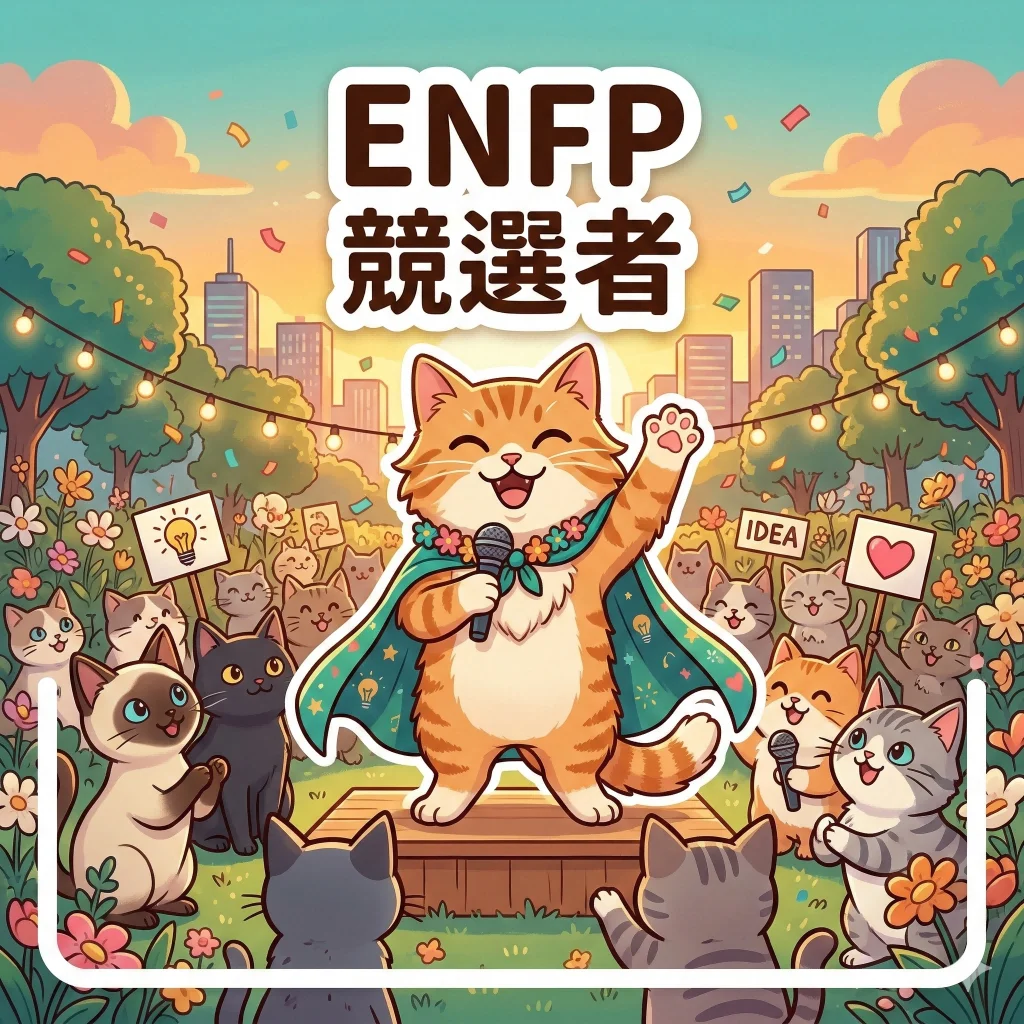
ENFP: the one who can see what it could become, from very little
By Ruby Wang (Wang Yi-Chun) — founder of Hour Light · 2026-09-17
ENFP usually gets translated as the free spirit, the campaigner, the enthusiastic one. All three describe the weather and none of them describe the climate. What actually runs underneath is a fast connective instinct pointed outward, sitting directly on top of a private and surprisingly immovable set of values. That combination is why you can look scattered from outside and feel, from inside, like the most consistent person you know. This page walks through what that looks like, and why two people with the same four letters can still feel like opposites.
What the four letters actually describe
The letters are not four separate traits stacked together. They point at an order of operations, which is the part most short descriptions skip.
The stack: Ne, then Fi, then Te, then Si
- Ne leads. Your first move is outward and connective. One thing suggests four others, and you are usually two links along before you notice you left the original subject.
- Fi supports. Underneath the openness is a private value system that does not negotiate. It is the reason you can be endlessly flexible about plans and completely immovable about one specific thing.
- Te sits underneath. Structure, sequence and follow-through are real skills you can use, and they cost you energy every single time rather than becoming automatic.
- Si comes last. Routine and accumulated detail are the weakest channel. Repetition does not settle you, it slowly drains you, which most advice about discipline gets exactly backwards.
What this looks like on an ordinary day
- You started the conversation about one thing and both of you left with a different, better thing.
- You can pick up a new field fast enough that people assume you have been doing it for years.
- You have several unfinished projects, and each one was genuinely worth starting.
- You agreed to something warmly, meant it entirely, and knew by the next morning it was a no.
That last one is the quiet cost. The yes came from the possibility, the no came from your values, and both were honestly yours. The gap between them is not flakiness, it is two functions answering in the wrong order.
The blind spot, stated plainly
ENFP rarely runs out of ideas. It runs out on the middle. The beginning is a pleasure and the end is a relief, but the long unremarkable stretch between them asks for exactly the function that sits last in your stack. So the work stalls at eighty per cent, and because everything you abandoned was genuinely promising, the pile of unfinished things becomes evidence against you in your own head.
The practical version: the problem is not commitment and it is not seriousness. It is that you have been trying to solve a structure problem with more enthusiasm. What actually works is borrowing the structure from outside yourself: a deadline someone else is waiting on, a person who will ask, a public commitment. Not discipline. Scaffolding.
Why two ENFPs can look nothing alike
This is where four letters stop being enough. Two people can share the same stack and still run it at completely different temperatures. We split ENFP along two axes: how openly you show what you feel, and how settled the situation has to be before you can move.
Shows it, needs things settled
The most visibly warm and the most affected by an unresolved relationship. Talks it through, wants it clear, and finds unspoken tension genuinely hard to sit with.
Shows it, can sit with open ends
Equally expressive and equally quick, but comfortable leaving a question open for months. The most recognisably ENFP of the four from outside.
Holds it in, needs things settled
Reads as thoughtful rather than exuberant. The ideas are just as fast; they get tested privately against the values before anything is said.
Holds it in, can sit with open ends
The quietest of the four and the one most often mistyped as introverted. Follows a thread wherever it goes, alone, and shares the result rather than the process.
If you read those four and could not tell which one you are, that is normal. Most people recognise themselves faster by answering questions than by reading descriptions.
Find out which ENFP you are 64-type test, 60 questions, instant result. Free, no sign-up.Where the label stops
A type describes a pattern of attention. It does not describe your history, your timing, or the situation you are sitting in right now. Anyone telling you that four letters predict your life is selling certainty, not insight.
We treat the type as one lens among several. It is a useful starting point precisely because it is easy to recognise yourself in, and it becomes more useful once you stop treating it as a verdict.
Work out the other lens → Your chart is arithmetic from a date, a time and a place — it does not care how you answered anything. Free, no sign-up, and you can read it next to this page.
What a full 37-system reading actually covers → A plain description of what is in it, what it costs, and who it is not for. No birth data needed to read that page.
Read this as a description to think with, not a diagnosis. It is not medical, psychological, legal or financial advice, and no personality result can promise an outcome.
Common questions
Is ENFP just the scattered one?
Scattered describes the output and gets the cause backwards. The leading function is a connective one, so attention genuinely does move fast and across subjects, but it moves along links rather than at random, and the links are usually real. What holds it together is the second function: a private value system that is close to fixed. That is why the same person can change plans five times in a week and be entirely unmoved on the one thing that actually matters to them. The fair criticism is not that you lack focus. It is that the follow-through function sits third, so finishing costs you real energy while starting costs you none.
Why do I only find out something was a no after I already said yes?
Because the two functions answer at different speeds. The first one is outward and fast: it sees what the thing could be, and a genuine yes comes out. The second one is inward and slower: it checks the thing against what you actually value, and it reports back hours or days later. Both answers are sincere, which is why this feels like being unreliable rather than like a sequencing problem. The workable fix is to stop trying to make the second function faster and simply put time in front of the first one. A standing habit of answering tomorrow costs you almost nothing and removes most of the apologising.
ENFP and ENTP look similar. What separates them?
They share the same leading function, so both are fast, associative and hard to keep on one subject. The difference is what sits underneath. The ENFP second function is a private value sense, so the possibilities get filtered by what feels right and the conversation tends to bend toward people and meaning. The ENTP second function is a private logic sense, so the possibilities get filtered by whether the reasoning holds, and the conversation tends to bend toward taking the argument apart. In practice an ENFP will follow an idea because it matters, and an ENTP will follow it because it does not hold together yet. Same speed, different test at the gate.
Is a personality type the same kind of thing as a birth chart?
No, and the difference matters more than which one you believe in. A personality type comes from your own answers: you report how you behave, and the instrument sorts that report. A birth chart is calculated from a date, a time and a place, so two people who answer nothing at all still get different charts. One is self-description, the other is arithmetic. We build with both and we keep them apart on purpose: the type is useful because you recognise yourself in it, the chart is useful because it does not care what mood you were in when you filled the form.
Take the free 64-type test Six-axis result, no email required.This is an independent guide inspired by Jungian type theory. It is not affiliated with, nor endorsed by, The Myers-Briggs Company. MBTI® and Myers-Briggs® are trademarks or registered trademarks of the Myers & Briggs Foundation, mentioned here only to describe the category.