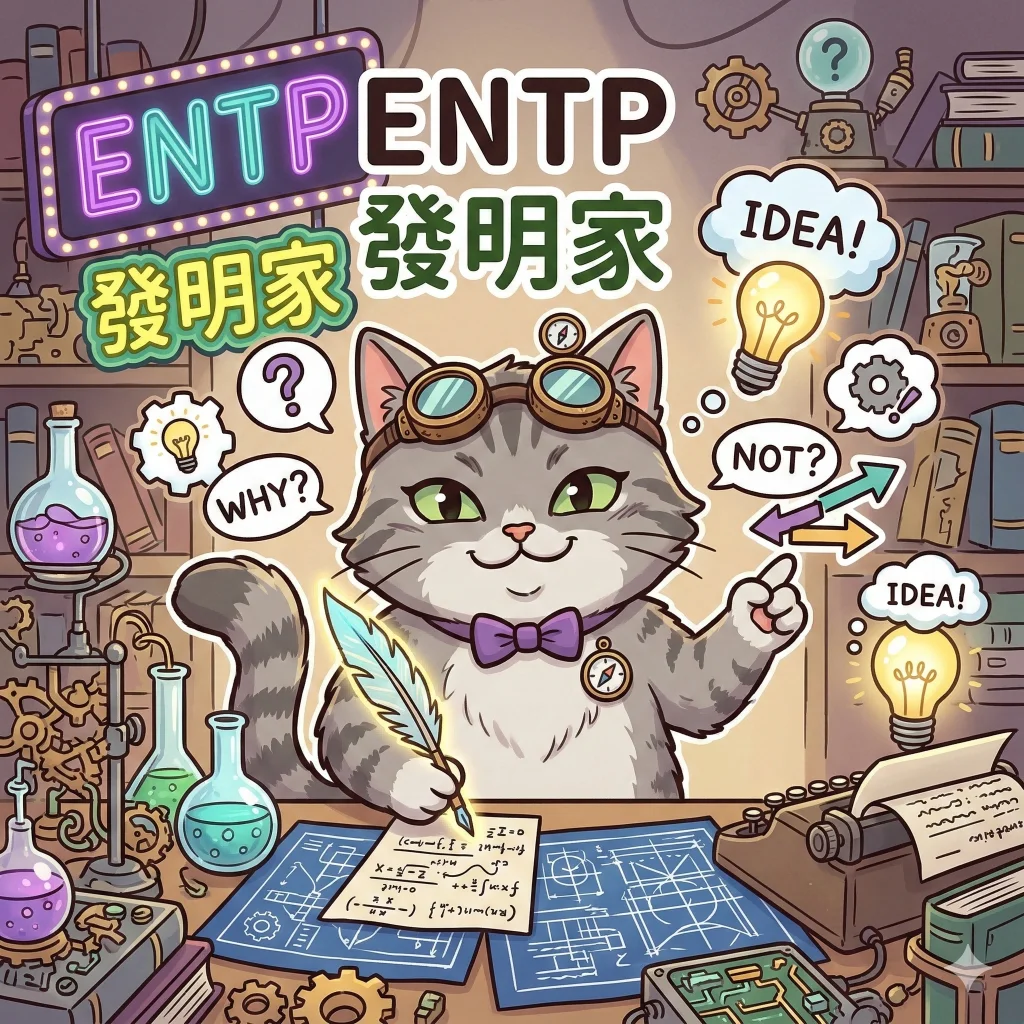
ENTP: the one who found the hole in it before you finished the sentence
By Ruby Wang (Wang Yi-Chun) — founder of Hour Light · 2026-09-17
ENTP gets handed the debater, the devil’s advocate, the one who argues for sport. Those describe an effect you have on conversations and skip what is producing it. What actually runs underneath is two fast moves in sequence: you see what else this could be, and then you test whether the version in front of you actually holds. The objection is not an attack. It is the second move happening out loud, which is an unusual thing to do and explains most of the trouble. This page walks through it from the inside, and why two people with the same four letters can still feel like opposites.
What the four letters actually describe
The letters are not four separate traits stacked together. They point at an order of operations, which is the part most short descriptions skip.
The stack: Ne, then Ti, then Fe, then Si
- Ne leads. Your first move is outward and connective: what else could this be, what is it like, what happens if you invert it. Alternatives arrive unbidden and in volume.
- Ti supports. The second move is a private consistency check. It is why you can generate five options and then dismantle four of them yourself within a minute.
- Fe sits underneath. Reading the room is a genuine capacity that arrives late. You usually notice the atmosphere has changed just after the sentence that changed it.
- Si comes last. Routine, upkeep and accumulated detail are the weakest channel. The admin does not feel boring so much as invisible until it is overdue.
What this looks like on an ordinary day
- You spotted the flaw before they finished explaining, and waiting was physically uncomfortable.
- You argued the opposite case to find out whether it held, and got read as disagreeing.
- You have solved the interesting eighty per cent of several things and shipped none of them.
- You were genuinely trying to help, and the room heard you showing off.
That last one is the quiet cost. Taking someone’s idea apart is, to you, the most respectful thing you can do with an idea. It reaches most people as a verdict on them, and you find out about the gap late, because the function that would have caught it sits third.
The blind spot, stated plainly
ENTP rarely loses the argument. It loses by winning it. You can be right, out loud, quickly, and watch the actual goal quietly move out of reach, because the thing you dismantled was also somebody’s work. The problem is not the sharpness of the analysis. It is that the analysis arrives without the half-second of context that would have let it land as help.
The practical version: you do not need to soften. You need to say what you are doing. One sentence before the objection, naming that you are testing it rather than rejecting it, changes what the room hears without changing a word of the content. It feels unnecessary to you precisely because it is the function that sits third in your stack.
Why two ENTPs can look nothing alike
This is where four letters stop being enough. Two people can share the same stack and still run it at completely different temperatures. We split ENTP along two axes: how openly you show what you feel, and how settled the situation has to be before you can move.
Shows it, needs things settled
The most visible version. Argues it out in the open and wants the question closed properly today. Reads as combative; is usually just unwilling to leave something half-tested.
Shows it, can sit with open ends
Equally quick and equally vocal, but happy to leave the question open indefinitely. The most recognisably ENTP of the four, and the hardest to pin to a position.
Holds it in, needs things settled
Reads as dry and precise rather than playful. The objections get run privately first, so fewer of them are voiced and the ones that are tend to land hard.
Holds it in, can sit with open ends
The quietest of the four and the one most often mistyped as INTP. Explores widely in private and shares conclusions rather than the argument that produced them.
If you read those four and could not tell which one you are, that is normal. Most people recognise themselves faster by answering questions than by reading descriptions.
Find out which ENTP you are 64-type test, 60 questions, instant result. Free, no sign-up.Where the label stops
A type describes a pattern of attention. It does not describe your history, your timing, or the situation you are sitting in right now. Anyone telling you that four letters predict your life is selling certainty, not insight.
We treat the type as one lens among several. It is a useful starting point precisely because it is easy to recognise yourself in, and it becomes more useful once you stop treating it as a verdict.
Work out the other lens → Your chart is arithmetic from a date, a time and a place — it does not care how you answered anything. Free, no sign-up, and you can read it next to this page.
What a full 37-system reading actually covers → A plain description of what is in it, what it costs, and who it is not for. No birth data needed to read that page.
Read this as a description to think with, not a diagnosis. It is not medical, psychological, legal or financial advice, and no personality result can promise an outcome.
Common questions
Is ENTP just someone who likes arguing?
The argument is a method, not an appetite, at least at the start. Your second function tests things by pushing on them, so taking the opposite position is how you find out whether a claim holds, including your own. That is why an ENTP will happily demolish an argument they agree with. The honest caveat is that the method is also entertaining, and a habit that is both useful and fun stops getting examined. Somewhere along the way testing can become performing, and the tell is simple: if you would still say it with nobody watching, it was the method. If not, it was the habit.
Why do I lose interest once I know how it would work?
Because the interesting part, for your stack, is the part that is still unresolved. Once you can see the shape of the solution, the leading function has nothing left to connect and the remaining work is execution, which runs on the function sitting last. So the drop is not laziness and it is not a failure of commitment: the fuel genuinely ran out. Two things help. Hand the finishing to someone whose stack is built for it, without treating that as a defeat. And when it has to be you, make the tail end interesting again by constraining it, because a deliberately harder version of the boring stretch is one your first function will still eat.
ENTP and INTP look similar. What separates them?
They run the same two functions in the opposite order, and the order changes almost everything about how it feels from outside. ENTP leads with outward possibility and supports it with private logic: the alternatives come first and in public, so ideas get tested in conversation and positions can look inconsistent while the thinking is live. INTP leads with private logic and supports it with outward possibility: the internal consistency check comes first, so the position arrives later, better defined, and usually with a qualification attached. Roughly, an ENTP thinks by talking and an INTP talks once it holds. Same curiosity, opposite order of arrival.
Is a personality type the same kind of thing as a birth chart?
No, and the difference matters more than which one you believe in. A personality type comes from your own answers: you report how you behave, and the instrument sorts that report. A birth chart is calculated from a date, a time and a place, so two people who answer nothing at all still get different charts. One is self-description, the other is arithmetic. We build with both and we keep them apart on purpose: the type is useful because you recognise yourself in it, the chart is useful because it does not care what mood you were in when you filled the form.
Take the free 64-type test Six-axis result, no email required.This is an independent guide inspired by Jungian type theory. It is not affiliated with, nor endorsed by, The Myers-Briggs Company. MBTI® and Myers-Briggs® are trademarks or registered trademarks of the Myers & Briggs Foundation, mentioned here only to describe the category.