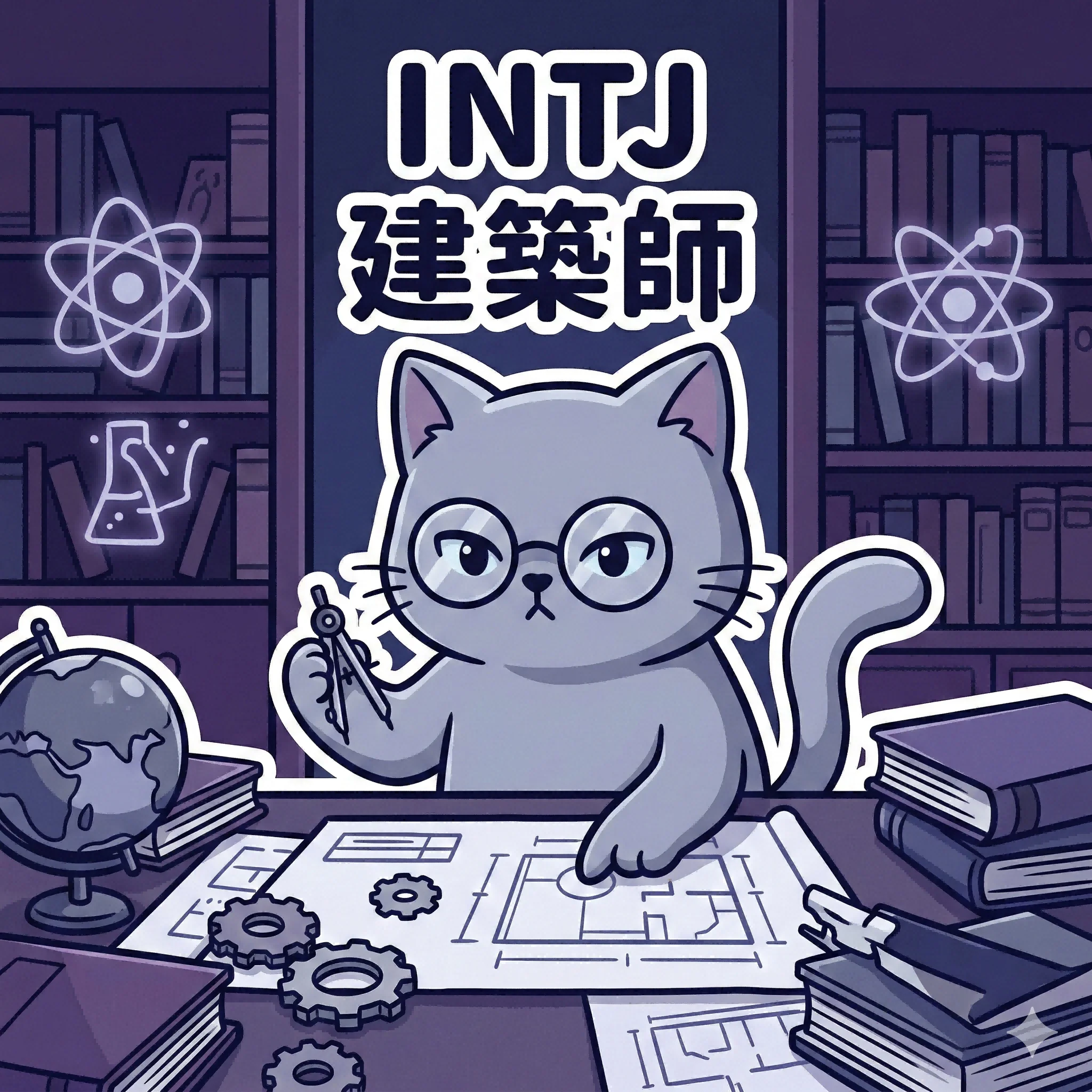
INTJ: the one who already decided and is being polite about it
By Ruby Wang (Wang Yi-Chun) — founder of Hour Light · 2026-09-16
INTJ gets handed the architect, the mastermind, and on a bad day the villain. Those labels are flattering enough to end the enquiry, which is the main problem with them. What actually runs underneath is narrower and less cinematic: you build a working model of how something behaves, the model keeps updating quietly in the background, and you find it very hard to act against it — including when the thing being modelled is a person. This page walks through what that looks like from the inside, and why two people with the same four letters can still feel like opposites.
What the four letters actually describe
The letters are not four separate traits stacked together. They point at an order of operations, which is the part most short descriptions skip.
The stack: Ni, then Te, then Fi, then Se
- Ni leads. You do not collect facts, you build a model of how the thing behaves. The model arrives before the argument for it does, which is why your conclusions can feel unarguable from the inside.
- Te supports. Your second move points outward and organisational: what is the shortest working route from here. It is also why the model reaches other people as a plan or a correction rather than a thought in progress.
- Fi sits underneath. Your values are private and close to non-negotiable. You rarely argue them out loud. You just quietly stop showing up.
- Se comes last. The physical present is the weakest muscle. You can plan three years ahead and still not notice that you have not eaten since breakfast.
What this looks like on an ordinary day
- You finished the plan during the first five minutes of the meeting and spent the rest of it waiting.
- You accept a correction instantly if it is correct, and people read that as coldness rather than the compliment it is.
- You would rather do it yourself than explain it, which is exactly how you ended up with all of it.
- You have ended things in your head weeks before you said anything out loud.
That last one is the quiet cost. The model updates in private, so when you finally speak you are reporting a decision rather than opening a conversation. Months of thinking reach the other person in one sentence, and they are not being unreasonable when they say it came out of nowhere.
The blind spot, stated plainly
INTJ rarely goes wrong on the analysis. It goes wrong by trusting the model after the thing it modelled has changed. You built it carefully, it has been right for a long time, and that track record is precisely what stops you re-opening it. The failure does not feel like being wrong. It feels like everyone else being slow.
The practical version: the problem is not your competence, and it is not the coldness you get accused of. It is that you treat “I have thought about this properly” as the end of the conversation. Naming one specific thing that would change your mind costs nothing and keeps the model alive.
Why two INTJs can look nothing alike
This is where four letters stop being enough. Two people can share the same stack and still run it at completely different temperatures. We split INTJ along two axes: how openly you show what you feel, and how settled the situation has to be before you can move.
Shows it, needs things settled
The most openly direct version. Argues the plan out loud and wants the decision today. Reads as blunt; is usually just impatient with ambiguity.
Shows it, can sit with open ends
Equally direct, but willing to leave the plan provisional while more comes in. Often the one who says not yet, and is right to.
Holds it in, needs things settled
Reads as composed and a little clipped. The pressure is entirely internal, which is why the eventual decision can look abrupt from outside.
Holds it in, can sit with open ends
The most self-contained of the four, and the one most often mistaken for arrogant. Usually the INTJ who has already run the whole thing to its conclusion alone.
If you read those four and could not tell which one you are, that is normal. Most people recognise themselves faster by answering questions than by reading descriptions.
Find out which INTJ you are 64-type test, 60 questions, instant result. Free, no sign-up.Where the label stops
A type describes a pattern of attention. It does not describe your history, your timing, or the situation you are sitting in right now. Anyone telling you that four letters predict your life is selling certainty, not insight.
We treat the type as one lens among several. It is a useful starting point precisely because it is easy to recognise yourself in, and it becomes more useful once you stop treating it as a verdict.
Read this as a description to think with, not a diagnosis. It is not medical, psychological, legal or financial advice, and no personality result can promise an outcome.
Common questions
Are INTJs really that rare, and does it change anything?
The percentages get quoted far more confidently than the evidence supports. The ones that circulate online mostly come from self-selected samples rather than representative populations, and the same instrument given to a different group moves the number. Treat any exact figure with suspicion, including ours. It is also worth noticing what the rare framing does when it is bolted onto the mastermind and architect labels: it turns a description into a small identity, and that is exactly the point at which a type stops being useful to you. How uncommon the pattern is has no bearing on whether it describes how you actually work.
Why do people read me as cold when I am trying to help?
Because of the order the functions come out in. Your second move is organisational, so the first thing that reaches the surface is a plan, a correction, or a faster route. The part that cares is real but it sits in the third function, stays private, and arrives late or not at all. So fixing the flaw in someone’s argument — which to you is the most respectful thing you can do with an argument — lands as dismissal of the person who made it. The fix is not to feel differently. It is to say the sentence you normally skip: that you are taking it seriously, and that the correction is the evidence.
INTJ and INTP look similar. What separates them?
They share two letters and almost nothing about how they move. INTJ leads with an inward pattern sense and supports it with outward structure: the first question is where this is going and what the shortest working route there is, so a conclusion tends to arrive as a plan. INTP leads with an inward logic sense and supports it with outward, open possibility: the first question is whether the reasoning holds, so a conclusion tends to arrive with a qualification attached. In practice the INTJ closes early and organises, while the INTP keeps the question open and is suspicious of closing at all. Same apparent detachment, different thing being protected.
Is a personality type the same kind of thing as a birth chart?
No, and the difference matters more than which one you believe in. A personality type comes from your own answers: you report how you behave, and the instrument sorts that report. A birth chart is calculated from a date, a time and a place, so two people who answer nothing at all still get different charts. One is self-description, the other is arithmetic. We build with both and we keep them apart on purpose: the type is useful because you recognise yourself in it, the chart is useful because it does not care what mood you were in when you filled the form.
Take the free 64-type test Six-axis result, no email required.This is an independent guide inspired by Jungian type theory. It is not affiliated with, nor endorsed by, The Myers-Briggs Company. MBTI® and Myers-Briggs® are trademarks or registered trademarks of the Myers & Briggs Foundation, mentioned here only to describe the category.