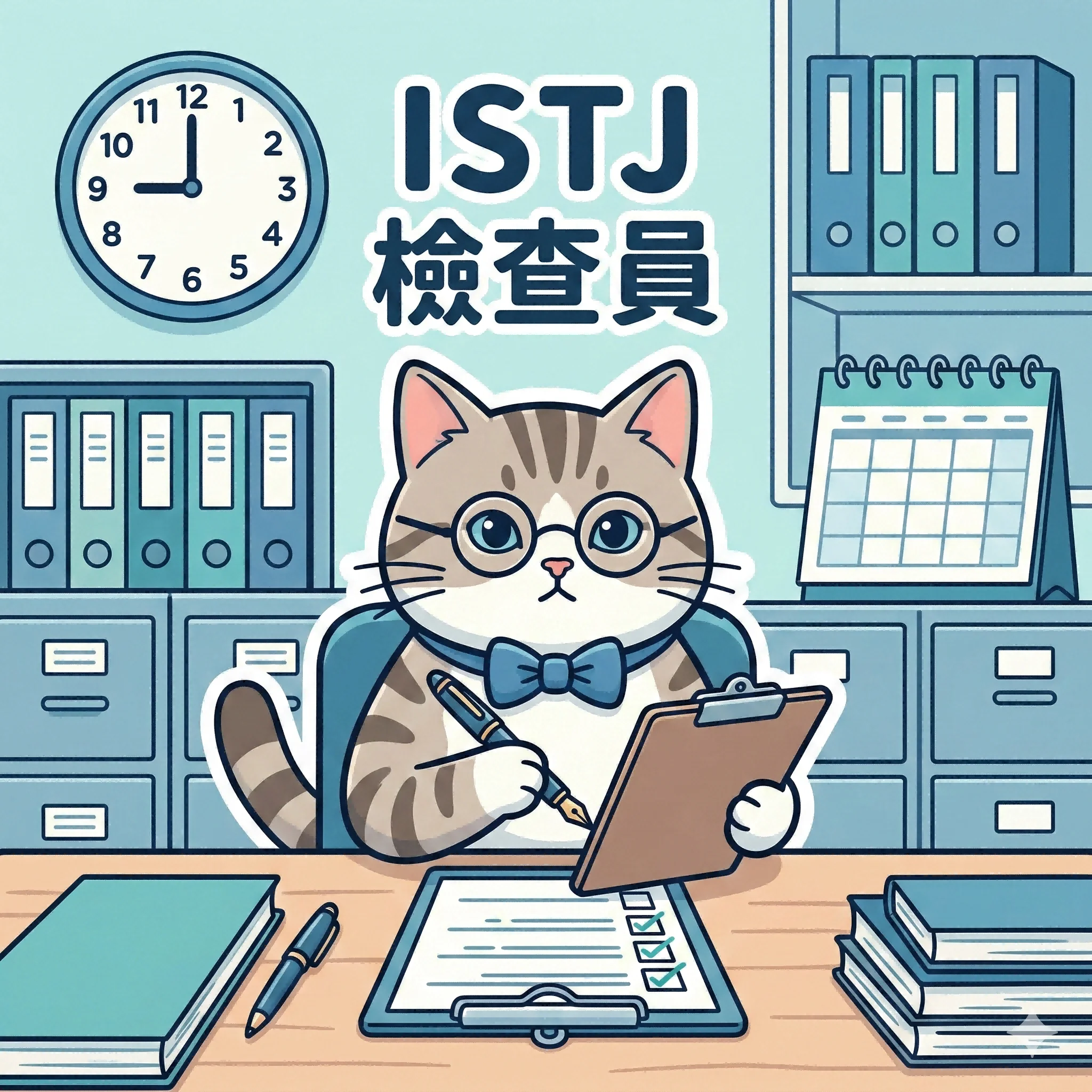
ISTJ: not rigid, just tired of redoing it
By Ruby Wang (Wang Yi-Chun) — founder of Hour Light · 2026-09-16
ISTJ gets handed the logistician, the inspector, and a quiet implication that this is the boring one. The word people actually mean is rigid, and it is the wrong read. What runs underneath is an accumulated record of how things have really gone, checked against whatever is being proposed now. When you push back on a new idea it is rarely because it is new. It is because the version of it that failed four years ago is still on file, and nobody else kept the file. This page walks through what that looks like from the inside, and why two people with the same four letters can still feel like opposites.
What the four letters actually describe
The letters are not four separate traits stacked together. They point at an order of operations, which is the part most short descriptions skip.
The stack: Si, then Te, then Fi, then Ne
- Si leads. You hold a detailed record of how things actually went, not how they were supposed to go. The gap between those two is the thing you notice first.
- Te supports. Your second move is to organise the outside world: define the step, give it an owner, write it down. It is why your objection usually arrives as a procedure rather than as an opinion.
- Fi sits underneath. Your sense of what is right is private and quite firm. You almost never argue it out loud. You simply decline.
- Ne comes last. Speculating about what might happen instead is the newest muscle. It is not a lack of imagination. Unbounded possibility just costs you far more than it costs the person proposing it.
What this looks like on an ordinary day
- You did the thing you said you would do, on the day you said it, and nobody mentioned it.
- You can tell within a minute that a plan has no owner, and saying so makes you the difficult one.
- You keep records that everyone else assumes somebody is keeping.
- You have absorbed other people’s unfinished work so often that it stopped registering as a favour.
That last one is the quiet cost. Competence attracts volume. Because you finish things without drama, work migrates towards you, and the migration is invisible to everybody, including you, for a long time.
The blind spot, stated plainly
ISTJ rarely goes wrong on execution. It goes wrong by treating the record as the whole picture. What you hold is an accurate account of what happened before, and it is the best evidence in the room right up to the moment the conditions change. Then the same precision that made you right for years is exactly what makes you late.
The practical version: the problem is not that you resist change, which is an accusation you have heard too often to hear properly any more. It is that your objection arrives as a conclusion instead of as the evidence behind it. Naming which earlier attempt you are comparing this to turns a veto back into information.
Why two ISTJs can look nothing alike
This is where four letters stop being enough. Two people can share the same stack and still run it at completely different temperatures. We split ISTJ along two axes: how openly you show what you feel, and how settled the situation has to be before you can move.
Shows it, needs things settled
The most openly insistent version. Raises the problem early and wants it closed before anything else moves. Reads as inflexible; is usually just refusing to pretend the gap is not there.
Shows it, can sit with open ends
Equally direct, but able to let a plan stay loose while it is genuinely still forming. Often the one who can say which part actually has to be fixed first.
Holds it in, needs things settled
Reads as reserved and slightly formal. The objection is fully formed internally, and often only appears once a deadline forces it out.
Holds it in, can sit with open ends
The quietest of the four, and the one most often mistaken for passive. Usually the ISTJ holding the most context and volunteering the least of it.
If you read those four and could not tell which one you are, that is normal. Most people recognise themselves faster by answering questions than by reading descriptions.
Find out which ISTJ you are 64-type test, 60 questions, instant result. Free, no sign-up.Where the label stops
A type describes a pattern of attention. It does not describe your history, your timing, or the situation you are sitting in right now. Anyone telling you that four letters predict your life is selling certainty, not insight.
We treat the type as one lens among several. It is a useful starting point precisely because it is easy to recognise yourself in, and it becomes more useful once you stop treating it as a verdict.
Read this as a description to think with, not a diagnosis. It is not medical, psychological, legal or financial advice, and no personality result can promise an outcome.
Common questions
Is ISTJ just the rigid one?
That is the stereotype and it gets cause and effect backwards. The lead function is a detailed record of how things have actually gone, so a new proposal is not being rejected for being new. It is being compared, silently, against one specific previous attempt. What looks like resistance is usually an unstated citation. Most percentages you will find quoted for this type came out of self-selected samples rather than representative populations, which is part of why the published figures disagree with each other. Ours included. The testable version is narrower: next time you object, check whether you said out loud which earlier case you were comparing this to. Most of the time you did not.
Why does everyone else's unfinished work end up with me?
Because finishing reliably is rarer than it looks, and it compounds. Your second function organises the outside world into defined steps, so you spot an ownerless task immediately, and it is genuinely faster for you to absorb it than to negotiate about it. Every time you do, the expectation moves, and nothing in the system records that it moved. The fix is not to become less reliable. It is to make the absorption visible at the moment it happens: say that you are taking it, say what you are not doing in order to take it, and let somebody else make the trade instead of paying for it privately yourself.
ISTJ and ESTJ look similar. What separates them?
Same two middle letters, different centre of gravity. ISTJ leads with the internal record and organises outwards second: the first move is to check this against what happened before, and the plan follows from the check. ESTJ leads with outward organisation and consults the record second: the first move is to get a structure in place, and the historical detail gets brought in to support it. In practice the ISTJ will not commit until the comparison is done, while the ESTJ will commit and then adjust. That is why an ISTJ can look slow to an ESTJ, why an ESTJ can look premature to an ISTJ, and why the pair of them working together usually lands in the right place.
Is a personality type the same kind of thing as a birth chart?
No, and the difference matters more than which one you believe in. A personality type comes from your own answers: you report how you behave, and the instrument sorts that report. A birth chart is calculated from a date, a time and a place, so two people who answer nothing at all still get different charts. One is self-description, the other is arithmetic. We build with both and we keep them apart on purpose: the type is useful because you recognise yourself in it, the chart is useful because it does not care what mood you were in when you filled the form.
Take the free 64-type test Six-axis result, no email required.This is an independent guide inspired by Jungian type theory. It is not affiliated with, nor endorsed by, The Myers-Briggs Company. MBTI® and Myers-Briggs® are trademarks or registered trademarks of the Myers & Briggs Foundation, mentioned here only to describe the category.