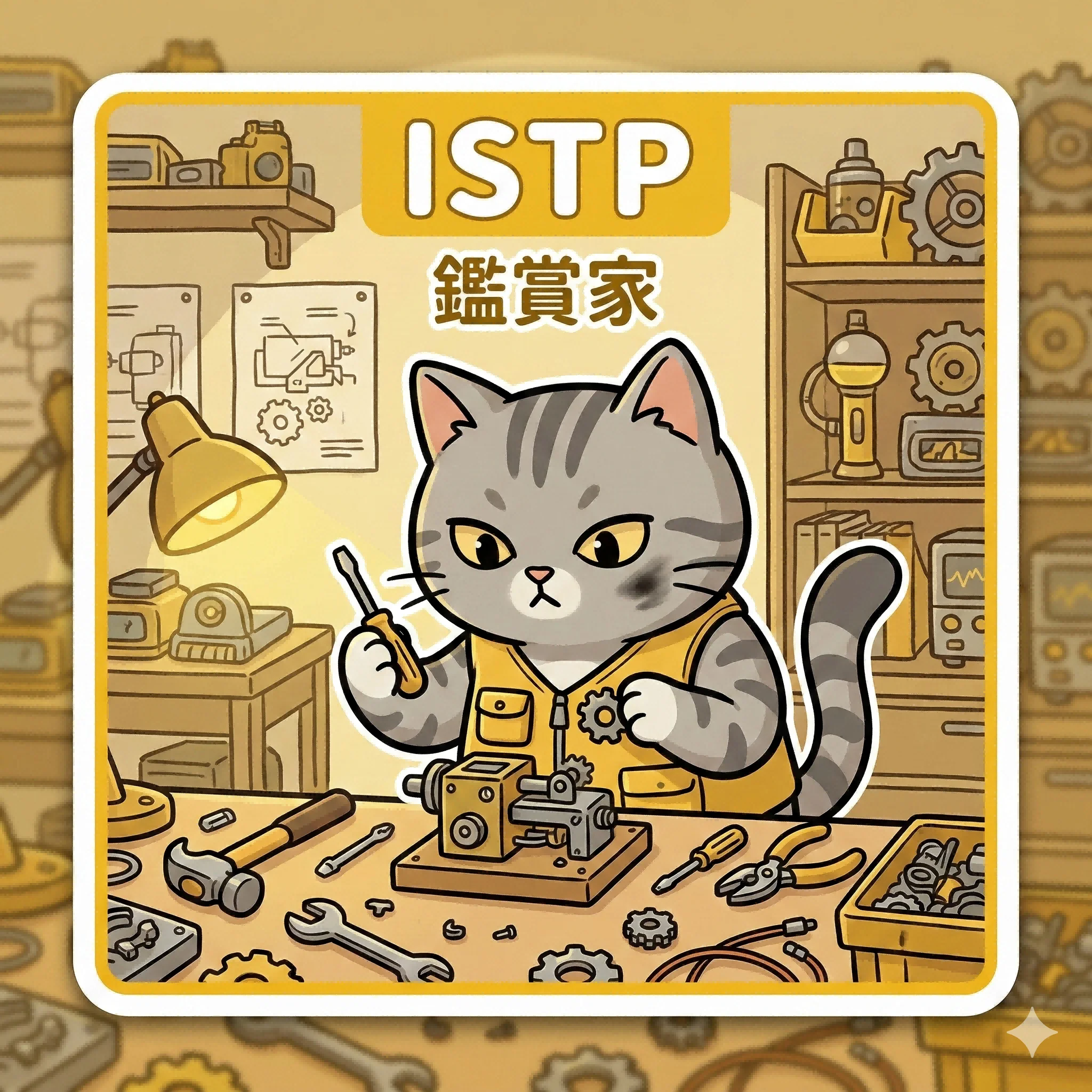
ISTP: the one who fixed it instead of discussing it
By Ruby Wang (Wang Yi-Chun) — founder of Hour Light · 2026-09-16
ISTP gets handed the virtuoso, the crafter, and a general impression of someone good with their hands. That is the visible half. What runs underneath is a private working model of how the thing actually operates, updated by handling it rather than by reading about it. You are not skipping the conversation about the problem out of rudeness. The conversation is simply slower than the check you can run directly, and it produces worse information. This page walks through what that looks like from the inside, and why two people with the same four letters can still feel like opposites.
What the four letters actually describe
The letters are not four separate traits stacked together. They point at an order of operations, which is the part most short descriptions skip.
The stack: Ti, then Se, then Ni, then Fe
- Ti leads. You work out how something functions by taking it apart, literally or mentally, and the answer has to satisfy you before it counts. A received explanation does not count.
- Se supports. Your second move goes straight into the present physical situation: what is actually in front of you right now, and what does it do when you change something.
- Ni sits underneath. Every so often a long-range read arrives fully formed and slightly ominous, and you have no idea where it came from.
- Fe comes last. The emotional weather of a group is the newest muscle. You do register it, usually late, and your first instinct is to solve it, which is not what was being asked for.
What this looks like on an ordinary day
- You fixed it while the meeting about it was still being scheduled.
- Being told how to do something you already understand is more tiring than the task.
- You go quiet under pressure, and people read the quiet as not caring.
- You are calmest in the situation everyone else is describing as an emergency.
That last one is not bravado. Urgency narrows the field down to what is physically in front of you, which is the exact condition your second function works best in. The cost arrives later, in an ordinary week, when nothing is urgent and nothing is interesting and you cannot explain to anyone why that is the harder one.
The blind spot, stated plainly
ISTP rarely goes wrong in the moment. It goes wrong on the things that only fail slowly: the conversation postponed, the commitment left deliberately vague, the relationship that needed maintenance rather than repair. None of them is urgent, so none of them reaches the top of the queue, and by the time one of them is urgent it is no longer a repair job.
The practical version: the problem is not that you avoid feelings, which is the version you have been handed and reasonably ignored. It is that your whole system is built for problems that announce themselves, and the important ones usually do not. Putting a date on the thing that has no deadline is the entire fix.
Why two ISTPs can look nothing alike
This is where four letters stop being enough. Two people can share the same stack and still run it at completely different temperatures. We split ISTP along two axes: how openly you show what you feel, and how settled the situation has to be before you can move.
Shows it, needs things settled
The most openly reactive version. Says what is wrong immediately and wants it dealt with now. Reads as abrupt; is usually just impatient with a problem being narrated instead of solved.
Shows it, can sit with open ends
Equally direct, and content to leave something half-finished until it becomes interesting again. Often the one who is genuinely unbothered by an unresolved situation.
Holds it in, needs things settled
Reads as flat and slightly impatient. The irritation is entirely internal, which is why the eventual exit can look sudden from outside.
Holds it in, can sit with open ends
The most self-contained of the four, and the one most often mistaken for indifferent. Usually the ISTP who has assessed the whole situation already and sees no reason to report it.
If you read those four and could not tell which one you are, that is normal. Most people recognise themselves faster by answering questions than by reading descriptions.
Find out which ISTP you are 64-type test, 60 questions, instant result. Free, no sign-up.Where the label stops
A type describes a pattern of attention. It does not describe your history, your timing, or the situation you are sitting in right now. Anyone telling you that four letters predict your life is selling certainty, not insight.
We treat the type as one lens among several. It is a useful starting point precisely because it is easy to recognise yourself in, and it becomes more useful once you stop treating it as a verdict.
Read this as a description to think with, not a diagnosis. It is not medical, psychological, legal or financial advice, and no personality result can promise an outcome.
Common questions
Is ISTP just the practical one?
Practical is the output, not the mechanism, and the difference matters. The lead function is an internal consistency check: you need to know how a thing really works before you will accept a statement about it. The second function points at the present physical world, so the fastest way to run that check is usually to handle the thing directly. That combination reads as hands-on, but it applies just as much to an argument, a contract or a piece of code. The type distributions you see quoted are drawn from people who chose to take a test online, so they describe test-takers and not populations. Ours are no better on that point.
Why do I shut down when someone gets emotional?
Because the function that handles group emotion sits last in your stack, and last does not mean absent. It means slow and expensive. What actually happens is a gap: you register that something is wrong, you cannot model it the way you model everything else, and your default response, which is to go quiet and look for the fix, is the single thing that makes it worse. Saying it was not indifference rarely helps afterwards, because the silence has already done the work. What helps is a smaller move made earlier: name the gap out loud. Saying that you can see it matters and you do not yet know what to say is more accurate than silence, and it is received completely differently.
ISTP and ISTJ look similar. What separates them?
Both are self-contained, both prefer doing to discussing, and their first moves differ in a way that shows up immediately under pressure. ISTP leads with an internal logic check and follows it straight into the present situation: the first question is how does this actually work, so the response is improvised and fast. ISTJ leads with the internal record and organises outwards: the first question is how has this gone before, so the response is procedural and prepared. Give them the same broken system and the ISTP will have it running before the ISTJ has finished establishing why it broke, while the ISTJ will be the one who notices it is going to break again.
Is a personality type the same kind of thing as a birth chart?
No, and the difference matters more than which one you believe in. A personality type comes from your own answers: you report how you behave, and the instrument sorts that report. A birth chart is calculated from a date, a time and a place, so two people who answer nothing at all still get different charts. One is self-description, the other is arithmetic. We build with both and we keep them apart on purpose: the type is useful because you recognise yourself in it, the chart is useful because it does not care what mood you were in when you filled the form.
Take the free 64-type test Six-axis result, no email required.This is an independent guide inspired by Jungian type theory. It is not affiliated with, nor endorsed by, The Myers-Briggs Company. MBTI® and Myers-Briggs® are trademarks or registered trademarks of the Myers & Briggs Foundation, mentioned here only to describe the category.